Build the construction
Specify tubing geometry, material layers, braids, coils, reinforcement, and single- or multilumen sections.
Explore design tools →CathCAD® helps catheter teams connect material selection, layer construction, reinforcement, and geometry to the mechanical behavior of composite tubing.
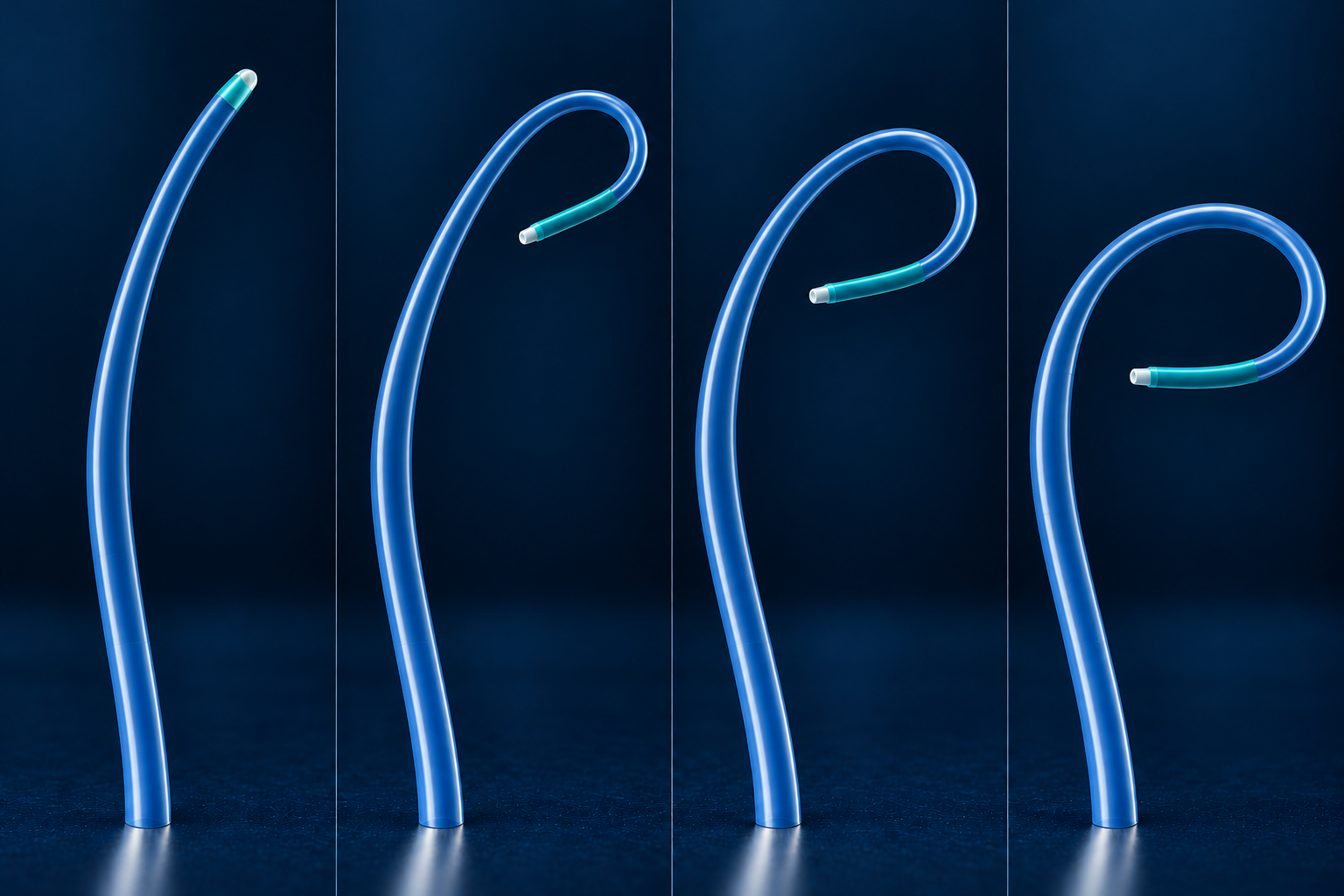
Define the catheter architecture and evaluate mechanical characteristics early, while the design is still easy to change.
Specify tubing geometry, material layers, braids, coils, reinforcement, and single- or multilumen sections.
Explore design tools →Analyze flexural, axial, and torsional rigidities, kink radius, tensile limits, and pressure-related performance.
See the engineering basis →Compare construction changes and prepare clearer design inputs for prototyping, testing, and manufacturing.
View training resources →Integrated into CathCAD®, Marketplace uses selected design parameters to find matching and near-matching components on Chamfr®. Review product details, then follow the product link to check pricing and availability and place your order.
Explore CathCAD® Marketplace
Adjacent polymer layers may blend during processing instead of remaining perfectly independent. CathCAD® models composite behavior with this manufacturing reality in mind.
Its validation is tied to physical catheter designs and measured behavior. The work captures catheter processes and connects analysis to real constructions.
How CathCAD approaches the model →“Advanced catheter modeling within reach.”Designed for established teams and startups with fixed budgets
A side-by-side snapshot of annual license prices for one-user and five-user packages.
| License | CathCAD® | Alternative platform | CathCAD® price difference |
|---|---|---|---|
| One user | $1,800/year | $3,495/year | $1,695 lower (48%) |
| Five users | $2,800/year | $15,495/year | $12,695 lower (82%) |
For informational purposes only. This is an independent comparison based on quoted or published annual license prices on October 30, 2026. It is not an endorsement, partnership, or representation by either software provider. Prices and license terms may change. Package features, support, and other terms may differ; confirm current pricing and package details directly with each provider before making a purchasing decision.
CathCAD connects to cloud-hosted material and braid-wire data. Each customer firm has a company-specific library shared by its licensed users, helping teams work from consistent modeling inputs.
Customer catheter designs are not stored in the cloud unless the customer explicitly authorizes it.
Read about materials and data handling →CathCAD®’s composite laminate model was developed and is owned by Roth Technologies. Its founder holds a Ph.D. from Georgia Tech, with academic minors in mechanics of materials and mathematics, and has more than ten patents.
That expertise is applied to the realities of catheter construction: material behavior, reinforcement, layer interaction, and manufacturing processes. The model is evaluated against physical catheter designs and test data.
We’re developing a web-based CathCAD experience. The current downloadable software remains available here.